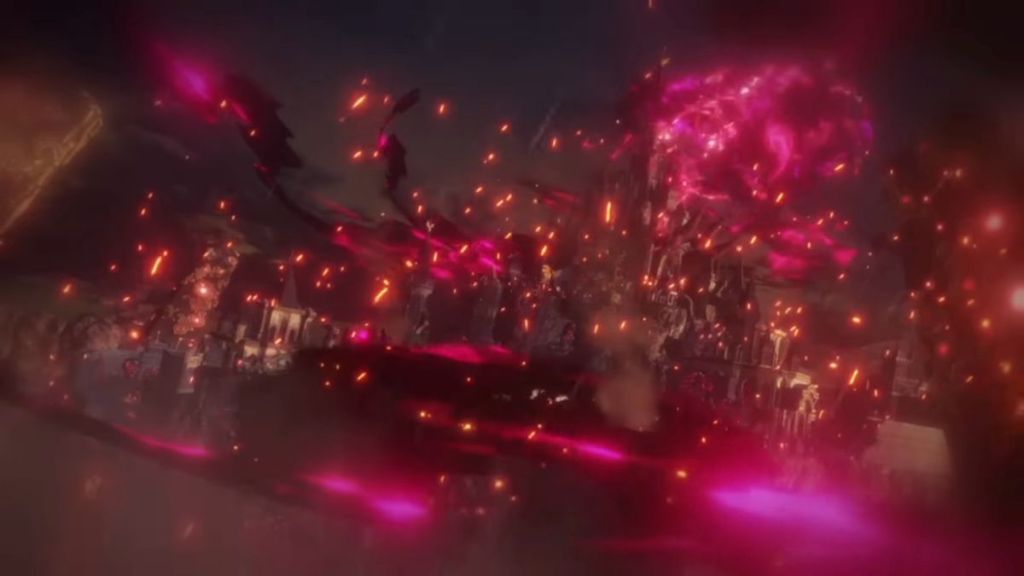
For this analysis, I have chosen one of Nintendo’s most significant games,The Legend of Zelda: Breath of the Wild. Nintendo developed it for the Nintendo Switch and Wii U in 2017. The game follows Link’s journey to save Princess Zelda after he awakens from a hundred-year sleep. Unlike earlier games from The Legend of Zelda franchise, Breath of the Wild places particular emphasis on free exploration and side quests. I chose this game because the story works very well with the open world, and it is especially interesting to analyze the symbols and narrative from a semiotic perspective, revealing deeper details and elements of the game’s lore.
For my analysis of the game, I decided to use three theoretical frameworks: ludology and narratology, GameFlow theory, and semiotics of video game space. The first concept is based on the debate between ludology and narratology in game studies. Ludology is a methodological approach based on making sense of the game as a system of rules and mechanics. By contrast, narratology is a study based on characters and narrative structure. Janet Murray’s criticizes the idea that games should only be studied as abstract rule systems and argues that narrative interpretation is also important. A fuller analysis, therefore, requires attention to both gameplay and narrative. Murray’s framework is suitable for The Breath of the Wild: earlier games are already known for strong plots, but this title introduces new mechanics and an open world, making the experience more dynamic and engaging.
The second concept is a GameFlow theory developed by Penelope Sweetser and Peta Wyeth. They adapted Mihaly Csikszentmihalyi’s psychological concept of flow to video games. Their model includes eight elements that will help to achieve enjoyment: concentration, challenge, skills, control, clear goals, feedback, immersion, and social interaction. Breath of the Wild consists of all eight elements. Shrines and side quests provide short-term clear goals and feedback, while the open world and detailed narrative encourage immersion and concentration. Also, players have a strong sense of control because they can usually decide what to do, and the game doesn’t force them to follow one path. At the same time, unexpected challenges such as extreme temperatures and powerful enemies test the player’s skills and maintain engagement. Social interaction also occurs; there are many communities where people share their thoughts and discuss the game. Therefore, GameFlow helps explain how the game keeps players engaged.
The third concept is semiotic. Semiotics is the study of signs and the way they produce meaning. Gabriele Aroni proposes a framework for analyzing virtual environments through ideas of architectural denotation and connotation derived from Umberto Eco. Aroni argues that architectural objects not only serve a mechanical role but also convey messages. This theory is also relevant to Breath of the Wild. After a hundred-year sleep, the main hero, Link, loses his memory, and the story is revealed through the environment. Abandoned and ruined villages scattered across the map suggest that a major calamity has occurred. Each village has its own architecture, and every climatic region is visually distinct. Hyrule Castle is both an important gameplay location and a powerful symbol of the destruction caused by Ganon. Sheikah shrines and towers, meanwhile, reveal the presence of an ancient technological civilization. Beyond their practical role as spaces for exploration that players can explore, these environments also connect gameplay mechanics with the history and lore of the world, allowing the player to understand Hyrule’s history through its architecture.
Therefore, these three concepts examine how the player experiences the game and how the environment creates meaning. Ludology and narratology help to study the relationship between the mechanics and the game’s lore. GameFlow explains how different parts of the game keep players engaged while moving through the story. Semiotics adds another level by showing how the architecture in the game communicates information about history and allows players to develop their own theories about the plot before these ideas are told through dialogue or cutscenes. The player discovers the narrative by moving through and interacting with the world, and the world itself becomes a form of storytelling.
An initial analysis shows that Breath of the Wild is shaped by player freedom, storytelling, and hidden symbolism. Firstly, the game avoids a strictly linear structure, allowing players to follow their own path through the story. This makes the player an active participant in shaping the experience. Secondly, success in the battles depends largely on the player’s skills, which improves the feeling of connection to personal experience. In addition, Link’s memory loss strengthens identification between the player and the protagonist because both discover Hyrule and its history at the same time. As a result, these elements make exploration meaningful by connecting the player’s personal experience with the game’s central themes and narrative.
Reference list:
- Allen, P. (2023, July 6). What is narratology? Perlego. Perlego Knowledge Base. https://www.perlego.com/knowledge/study-guides/what-is-narratology
- Aroni, G. (2025). The semiotics of video game spaces. Signata, 16. https://doi.org/10.4000/14rho
- Espen Aarseth. (2023, April 28). Ludology. ResearchGate. https://www.researchgate.net/publication/370389692_Ludology
- Murray, J. (2005, June 17). The last word on Ludology v Narratology in game studies. unknown. ResearchGate. https://www.researchgate.net/publication/335541373_The_Last_Word_on_Ludology_v_Narratology_in_Game_Studies
- Sweetser, P., & Wyeth, P. (2005). GameFlow: A model for evaluating player enjoyment in games. Computers in Entertainment, 3(3), 3. https://doi.org/10.1145/1077246.1077253

